Red Shoulder Hawk

Red Shoulder Hawk

Thursday, November 30, 2006

Rough sketch, exterior of 835 60th


My architect friend, Dan Swain, suggested a method for getting the retrofit project funded by building another unit at the end of the house, first. I started thinking about that, and realized it was an amazing "stacking functions" solution.

I'm imagining a small unit, perhaps 700 square feet (15'x26' footprint). Roof lines could echo the false roof lines from the past turn of the century. A commonspace patio up on top would get oodles of sunlight, being up out of the shade of our willow, making it a great spot for a living roof. Rain water harvesting would nourish dwarf fruit trees and an edible garden. After the larger remodel, some space up there could become private patio for the taller three-floor unit. Some of the new building could be a common laundry and toilet. If this laundry room were on the second floor, the gray water could go into a tank for the ground floor, backyard garden.

This unit could be offered for sale or be a pressure relief space during the larger remodel.

Monday, November 27, 2006

Fairy Houses


I grew up in the age of the Cocktail Party. I remember being sent to bed (along with my brothers) while the grownups laughed and carried on at the front of the house, about once a month as the drinks rotation passed through my parents' home.

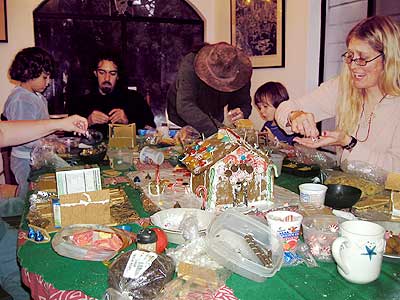
Finally realizing I had an expectation that as an adult, I'd be having parties filled with laughter and fun, I'm saying yes to having events such as this weekend's big feast (we carved up a 25 pound organic turkey!) as well as making gingerbread houses yesterday. I was a big hit with the grown-ups as I was pouring Irish Coffees. We only went through half a bottle of Bushmills, but it mellowed us out just enough to be really patient with all the little fingers and the icing and the waiting for parts to set up.

Clare spearheaded the decorating, in that she kept talking about it until we made it happen. I invited the neighbor kids from the cohousing, and we made "fairy houses."

George put in his two cents worth: "I've been learning a lot about how toxic sugar is to the body, so I think it's a good idea if the children don't eat any of the candy."

"There's organic dried fruit as well as about a dozen kinds of candy," I told one dad, as I handed him a beer.

He said, "Most of the year, I'd steer him away from the sugar, but as I look at this table, I can see there's no way I could realistically expect my son to not eat candy today. I'm going to just let him enjoy himself."

I noticed the boy ate one candy cane and a few gumdrops.

We partied from about 1:30 in the afternoon until past dinnertime. I brought out the turkey carcass and people made turkey sandwiches. George rendered the remains into soup. It was very tasty.

Tuesday, November 21, 2006

The EPA cares about People, Prosperity, and the Planet

I recall when the EPA had backbone, when they forced corporations to clean up after themselves. I also recall later, when they began to loose their teeth, and they seemed to function as an Orwellian, double-speaking front organization for logging and oil interests. I don't have a good read on them these days, but they are sponsoring a nifty competition called "P3." I strongly encourage students to look into this and enter. Students and their faculty advisors compete for EPA's P3 Award and the opportunity of up to an additional $75,000 in funding to move their designs to the marketplace or implement them in the field.

I would hope a winning team would take two things that are problems by themselves and combine them into a solution. For example, in Los Angeles, they finally combined the problem of so much rain in the winter overtaxing the storm drain system with the problem of not enough water in the summer and a new municipal rain catchment system promises to solve both problems.

Sunday, November 19, 2006

California's first constructed wetlands with a permit!


Over the course of the last few years, anyone who is savvy to the local eco scene has said to me, "Bob, have you been to the Ecohouse in Berkeley?"

"No, I haven't."

"O my gosh, you simply must go!"

I have tried several times to get there, but the place doesn't keep "hours." My friend Paki included me on an email distribution, and so now I've been.

It's astonishing.

Situated between a couple of community gardens, this tiny home is the site of several amazing, sustainable technologies. Today there was a living roof workshop and the tail end of the gray water workshop. John Russell has designed and orchestrated the construction of a residential waste-water treatment system. It's the first permitted constructed wetlands in the state!

There's a great giant hole in the ground, filled with various grades of crushed rock. It's perhaps 8 feet in diameter, with an island perhaps 4 feet across in the middle. Up to 350 gallons per day could flow through it, so it is a model a largish family could use. Water flows through all the pore spaces of the rocks, and bacteria does the jobs of purifying it. From the rock bed the water then flows into a set of bark-filled troughs, where it percolates into the soil and provides plenty of water for fruit trees and other gardefn edibles.

In order to secure the permit, there are some design aspects such as the ability to drain the entire system, or to shut it down entirely and divert waste water back into the city sewer system (during heavy rains, for example). Also, the water never reaches the surface, and only relatively clean water is allowed into the system; the kitchen sink water is still considered part of the black water system.

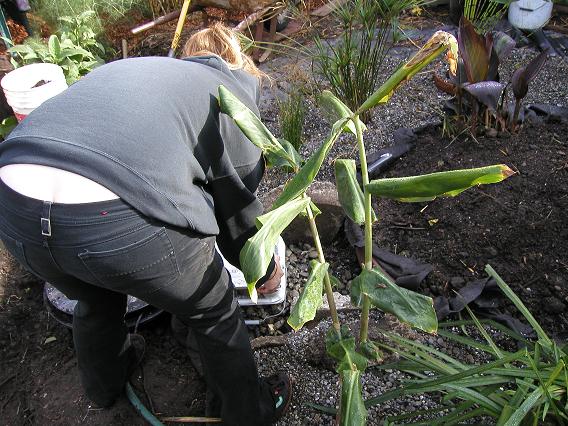
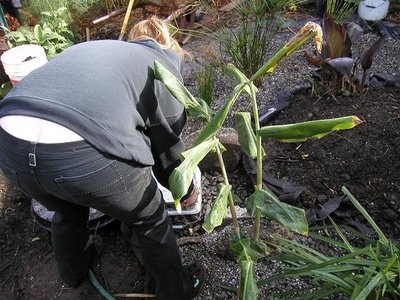
I worked alongside many of my friends of permaculture today, moving rocks and dirt, laughing and catching up. Everyone is pretty interested in helping me get the project here more fully underway. That's encouraging! Perhaps I'll help build the state's first multi-tenant permitted constructed wetlands, which includes some open water and a pond!

Friday, November 03, 2006

Rain catchment version 0.1

We've begun collecting rainwater!

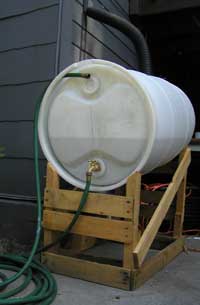
This is a HDPE barrel set atop a shipping pallet that I took apart and rebuilt into a frame. George and I worked on these together! In typical George fashion, he started on the project and insisted that I help NOW even though I was already time committed in two other places and activities, but I kept my cool and negotiated a solution that worked out.

George collected a set of 55 gallon plastic barrels from Pyramid Brewery. These barrels held liquid apricot flavoring (and they still smelled really yummy). I went out and bought new spigots (or hose bibs, for those of you who love correct terminology) which threaded right in to some nice holes in the barrel's caps. Together, we re-worked the downspouts to shunt water away from the foundation and into the barrels.

55 gallons of water isn't really much, but the barrels and the pallets were free, several yards of ribbed drain hose was $20 from Urban Ore, and the spigots were just $4 each. This system is intended for two things: to start us in the practice of catching rain, and to keep the ground floor of the house dry. It does those things. Unintended benefits include successfully working on a project with George.

Some specific design elements:
There's a wire mesh screen at the top of the barrel to filter out leaves and such. I put it there so I can reach it to clean it out without climbing a ladder.
We used the barrel on its side because that gave us access to the female threads for the spigot.
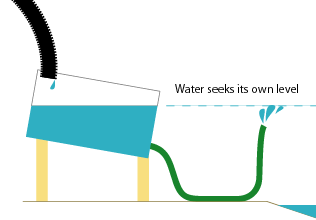
The barrel is up off the ground so we get a little bit of pressure head on the stored water (rain comes out of the sky, so it costs no energy at all to store it up high. In the future, I'd like to have a catchment system that was 10 feet off the ground).
My plan for what to do when the barrel fills up is to place the end of the hose so it acts as the overflow regulator. I can tie the hose to a stake and hold the end up so it matches the water level in the barrel, and direct extra rain to anywhere within the reach of the hose.

Hubble museum on the moon

I'm trying to save the Hubble Space Telescope for future generations. New Scientist gave me a spot on their blog.